Blog #1: The Cat and the Click
A short reflection on Schrödinger’s Cat. What it really means, what it doesn’t, and how revisiting it helped me see things a little differently.
I came across this reel recently and, revisited “The Schrödinger’s Cat”. You know those moments when something you’ve known suddenly makes sense, not in the intellectual way, but in a deep, bodily way? Epiphany. Lightbulb moment. Eureka. Whatever name we give it, it’s not really about learning something new. It’s about finally seeing something old as if for the first time. Today, that happened to me.
Bear with me; I’m trying to resist the urge to jump straight to the meat of what I want to say. Or maybe there’s a lot to say and therefore, nothing. The best I can and should do right now is apply a little constraint.
And since we’re talking physics, let’s revisit the concept using a bit of the Feynman technique. Let me ELI5, or ELI10, perhaps, because I suspect the ten year old me might have been smarter and wiser than I am now (Why? That’s something we can dig into another day, I guess).
ELI10 Part 1: Quantum Superposition
To begin with we have to first understand what superposition is. Now, If you flip a coin and cover it, it’s definitely either heads or tails. You just don’t know which one until you look.
And, if you know everything; from the weight of the coin, to the way with which your thumb flicked it, you could, in principle, predict exactly which side will face up at any point in time.
Now, shrink this coin. Make it smaller. Smaller still. Tinier than you can imagine tiny to be. Here, the coin gets magical. This magical coin — is it heads, tails, both, neither, or something in between? We don’t know. All we can really say is that it’s none of the above, that all possible answers have some potential for being true simultaneously because the coin simply is. And that, right there, is superposition.
This, I know, is very strange because it defies the way things work in our big, everyday world. I our big, everyday world, just like our normal coin, things are entirely deterministic. That means, if we have all of the information about a system, we can, in principle, predict with absolute certainty the state of the system at any point in time. But the very tiny world (the quantum world), the world from which our magical coin belongs to, is entirely probabilistic, meaning that no matter how much information we have about a system, we can’t ever determine with certainty what state it will be in.
ELI10 Part 2: Interpretation, Observation, and the Cat
While our language struggles to describe this kind of magic, mathematics steps in to help. Physicists use something called a wave function, a kind of mathematical spell book, to keep track of all the possible states the magical coin (and things similar to it) could be in.
But what does this spellbook actually tell us about the system? How do we interpret it? The most common interpretation both in Schrödinger’s time and today is what’s called the Copenhagen Interpretation.
According to the Copenhagen Interpretation, our magical coin is both heads and tails until you take a look at it. That is, the system exists simultaneously in all possible states until an observation is made. The moment you observe, the wave of possibilities collapses into a single outcome (measurement problem).
Erwin Schrödinger was not a fan of this seemingly absurd interpretation. He proposed the Cat experiment against the interpretation. Here is his thought experiment:
- The Box and the Setup: We put a cat inside a sealed box. Inside the box, we have the magical coin (which is actually a radioactive atom with a 50% chance of decaying)
- The Deadly Link: We connect this atom to a complex machine (a detector) that holds a vial of poison. If the atom decays, the detector senses it, and the vial breaks, killing the cat. If the atom does not decay, the cat lives.
- The Paradoxical State: According to the rules of superposition, the atom, before observation, is simultaneously decayed AND undecayed, and the detector has both detected and not detected radiation, so the vial of poison is both broken and unbroken. The cat must then, logically, be in a superposition of being alive AND dead at the same time.
ELI10 Part 3: Why the Cat Isn’t Both
The quantum world is weird and Schrödinger’s cat experiment illustrates that really well. But what most peopole don’t realize is this:
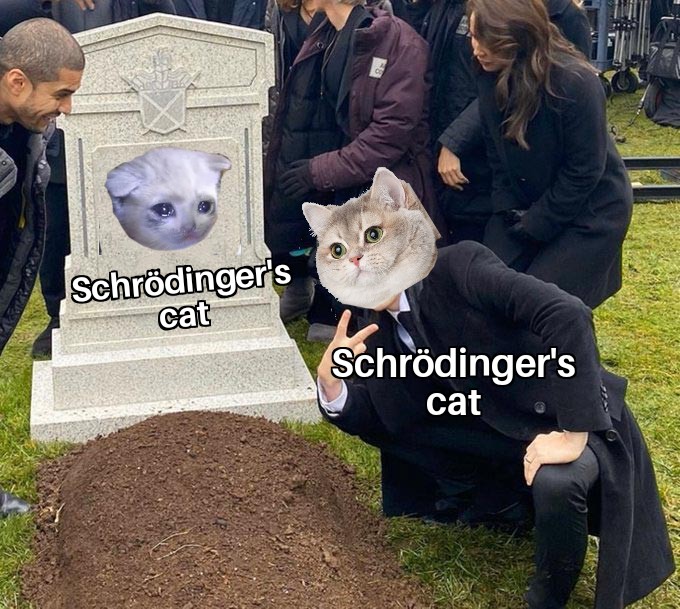
- Schrodinger wasn’t saying that the cat is both alive and dead. He was arguing that it can’t be, and that this absurd implication shows something must be wrong (or at least incomplete) in how we understand about the quantum world.
- His overall argument that the Copenhagen Interpretation is wrong was itself flawed. The cat still can’t be both alive and dead, but the reason why is far more subtle.
Many people think the superposition lasts until a conscious person looks inside the box (an act called “observation”). But the important moment is interaction. The moment the tiny radioactive atom interacts with the macroscopic detector inside the box, the superposition of the atom is immediately broken.The detector forces the quantum system to choose its state.
Because the atom interacts with the detector, the chain of events, that is, poison released or not released, is set right then and there. Even if the box remains closed forever, the cat is already definitively alive OR dead, not both. In other words, The superposition of the atom does not extend to the superposition of the cat.
The Quantum Grammar
To see why this was such a rupture, it helps to recall what came before. In classical physics, the world ran on a deterministic grammar. If you knew all the forces, positions, and velocities, you could predict everything from falling apples to orbiting planets. The logic was Boolean: true or false, this or that. Probability was merely ignorance: the world had a definite state; you just didn’t know it yet. Quantum mechanics shattered that grammar. The world turned out to be non-deterministic, contextual, and fundamentally probabilistic.
The very syntax of what was known to us broke. And once you see that, you can’t unsee it.
When this finally clicked, I began to connect. It has become another lens, in my arsenal, through which to look at everything else: not just particles and equations, but choices, beliefs, identities, even meaning itself. You start noticing how much of life is built on superpositions; of possibilities, perceptions, and interpretations that collapse only when we act, or decide, or observe.
The first connection was obvious: decision-making sciences — economics, politics, psychology. Quantum Cognition, which borrows the mathematics of quantum mechanics not because our brains are quantum computers, but because human thought behaves in surprisingly similar ways.
Alexander Wendt, in Quantum Mind and Social Science, extends this grammar even further, suggesting that societies and institutions themselves might exhibit quantum-like contextuality.
The challenge, whether in physics or in life, is learning when to observe and when to let the wave evolve.”
The Quantum Grammar and my present state
Lately, as I’ve been pursuing a fellowship to understand the Founder’s Office role, this way of seeing has felt strangely relevant. The Founder’s Office, in many ways, lives in superposition. It exists somewhere between strategy and execution, vision and reality, chaos and coherence. You’re not just solving problems, you’re defining what the problem is. You’re not just managing certainty, you’re navigating gradients of probability, timing, and context.
It’s a world where observation matters. Look too early, and the idea collapses before it’s ready. Look too late, and you’ve missed the window. The trick is knowing when to observe, when to collapse possibilities into decisions, and when to let them stay open and interfere with each other a bit longer.
So, I’ve slowly begun building a playbook around this idea, a grammar that balances all those competing wave functions of possibility — product, people, timing, market, emotion — and chooses when and how to collapse them into action. That’s what I’m trying to understand, bit by bit, and even codify.
Still Learning to See
I’m still exploring all of this. The small moment of understanding has again opened many others. This reminds me how powerful relearning can be, how returning to something familiar with a new mind can trigger entire chains of thought.
Conclusions have always been difficult for me, so I won’t force one here.
Everyone, in their own ways, develops lenses to see and understand the world around them. I just happen to be more drawn to those that are mathematical or science inspired because despite their equations and symbols, the abstract to me is way of seeing the world, of paying attention.